Idée politique
Fiche éditée par / Alexandre HarismendyDans l'architecture d'une société, la politique est un organisme inhérent à son fonctionnement naturel. Il incombe alors à chaque membre de ladite société de concevoir son organisation de la politique, la représentation qu'il s'en fait, quelles conditions voit-il nécessaires à l'exercice du pouvoir. Précisément, toute représentation personnelle des "choses de la cité" selon l'étymologie grecque, implique donc une idée politique. Ainsi, cette dernière peut se développer au gré des changements, bouleversements, crises que rencontre la société et se voit éventuellement régie par des codes, des théories, des doctrines auxquelles il est libre ou non d'adhérer. L'idée politique purement réflexive se meut également en source, en objet. Lorsque la politique rencontre l'image, la méthode scientifique de l'iconographe peine à trouver son chemin, annihilée par ce noyau subjectif né d'une représentation sociale et d'une représentation matérielle. En cela, le travail historiographique de l'historien de l'art est une navigation continue au cœur des idées politiques, dont l'histoire offre en conséquence divers biais d'analyse et de compréhension de l'image.
Commentaires (0)
Dès lors que la notion d'identité nationale est évoquée, il devient impossible de la dissocier d'une idéologie politique. D'autres facteurs comme les traditions culturelles et institutions historiques nourrissent cette dimension idéologique. Inconsciemment, la lecture de l'image obéit à ces normes, parfois non moins pertinentes mais parfois faussant la démarche scientifique.
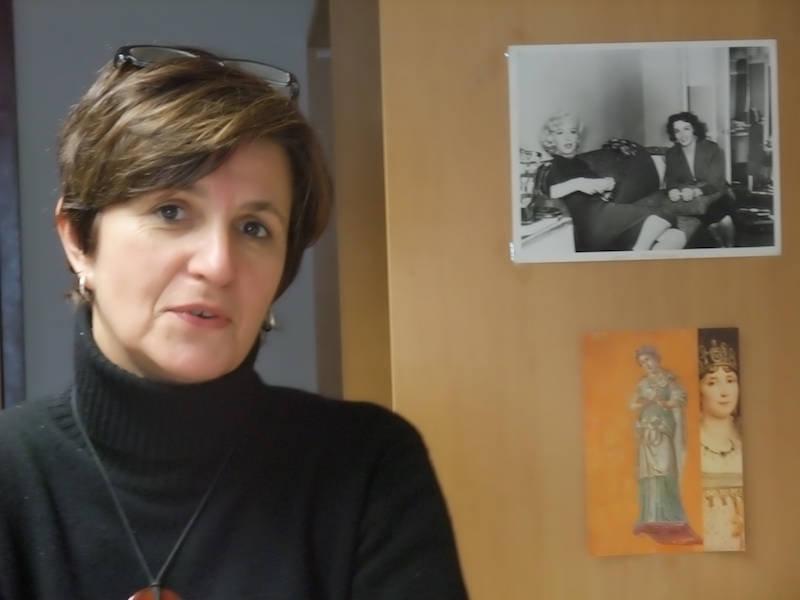 Martine Denoyelle July 2010
« On peut encore distinguer des écoles nationales dans mon domaine. Dans l'interprétations des vases grecs par exemple. On de grandes tendances nationales qui subsistent. Ne serait-ce qu'ici par exemple. Nous avons une Ecole de Paris. Qui a une lecture des images qui est spécifique. Qui a apporté beaucoup de choses. Les Américains en ont une autre. Beaucoup plus littéraire. Plus tournée vers les rapports des images à la civilisation grecque en général. Et ainsi de suite. Je pense qu'il subsiste des tendances nationales. » 4.1
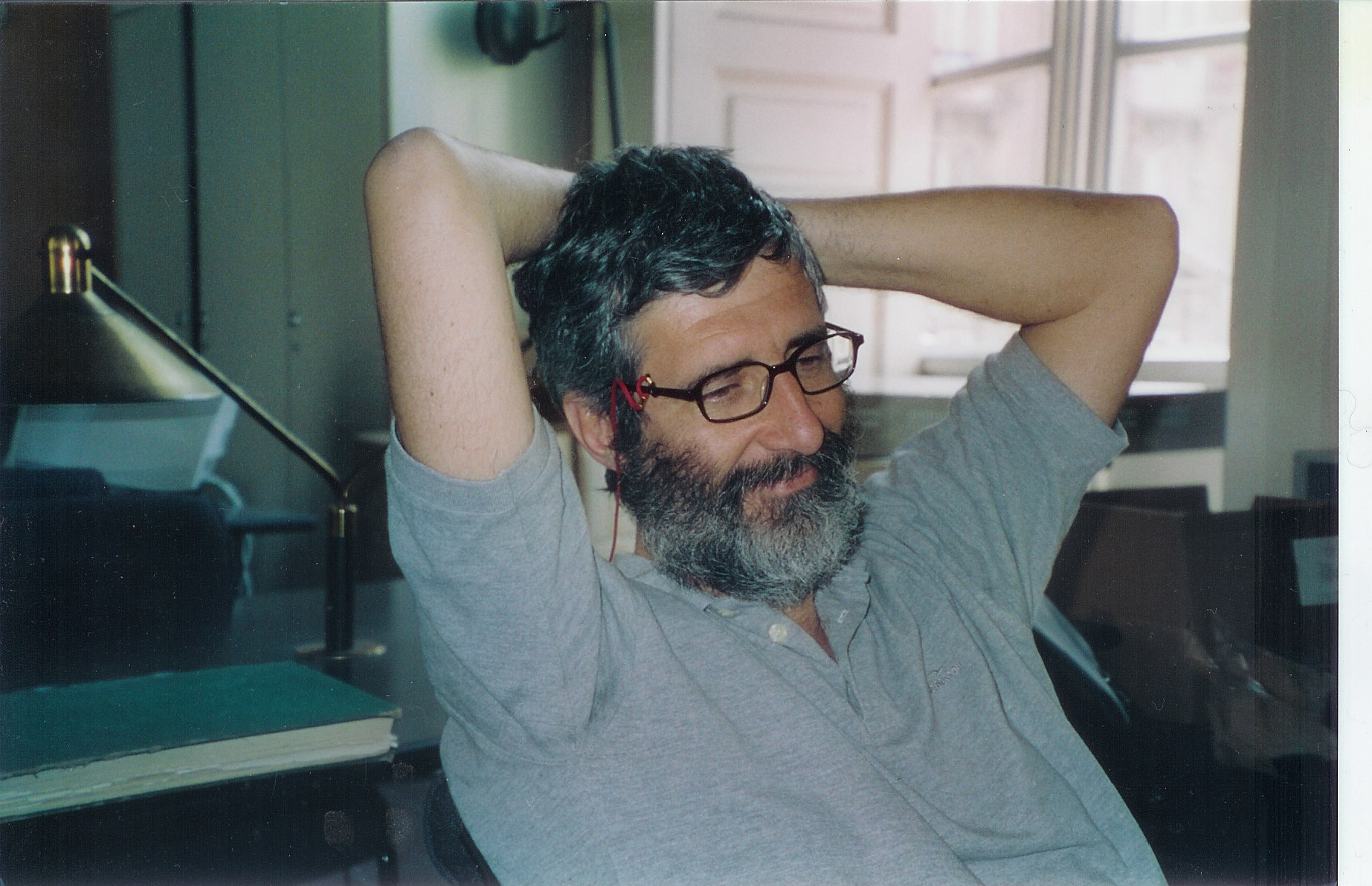 Luca Cerchiai
« Penso che la lettura delle immagini rifletta tendenzialmente i grandi filoni di ricerca propri delle tradizioni culturali nazionali. All’interno di questa tendenza più generale, facilmente riscontrabile nel panorama internazionale degli studi, si sono poi sviluppate le concrete strategie di ricerca dove è entrata in gioco la formazione specifica degli studiosi che, singolarmente o in gruppo, hanno affrontato il lavoro sull’immaginario alla luce di dichiarati principi metodologici. Questo è, evidente in campo italiano dove, sia pure in un quadro articolato di posizioni, lo studio delle immagini si è sviluppato con un approccio che si è sforzato di integrare una prospettiva marxista ad una lettura di carattere antropologico, in una dimensione culturale che riflette l’esperienza intellettuale di Dialoghi di Archeologia. » 4.1
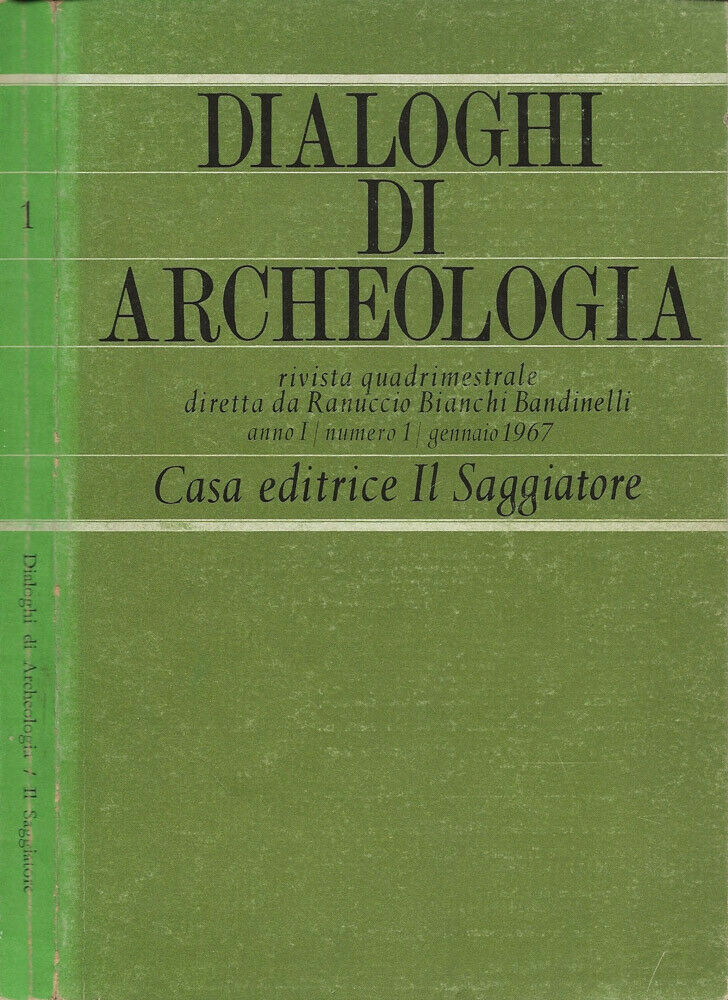
Premier numéro de la revue Dialoghi di Archeologia, publié sous la direction de Ranuccio Bianchi Bandinelli aux éditions Il Saggiatore en 1967 – Source : https://antiquipop.hypotheses.org/10117
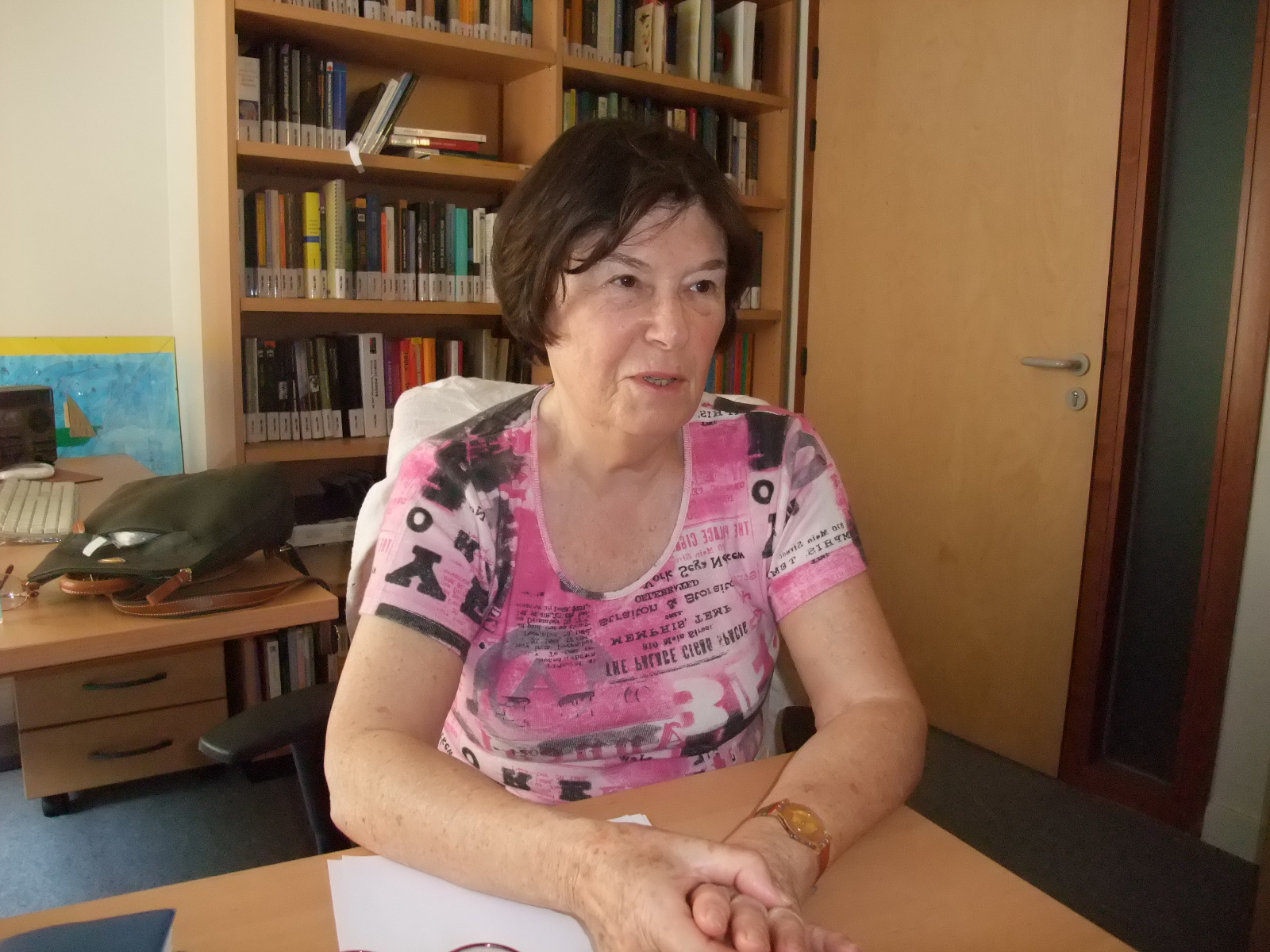 Françoise Frontisi-Ducroux March 2010
« Oui, bien entendu, les traditions académiques, les cultures nationales, les idées politiques ont influencé les lectures des images, toujours, peut-être encore maintenant, probablement. Les Anglais, les Allemands ne lisent pas les images de la même façon. Les traditions académiques aussi, y compris à l’intérieur de la France. Lesquelles me semblent encore actives ? Je ne peux pas donner des exemples. » 4.1
 Marie-Christine Villanueva-Puig September 2012
« Je pense que, pour ce qui est de l’image en archéologie, c’est extrêmement actif à l’heure actuelle et que dans ma pratique, j’y suis confrontée sans arrêt, parce que les pays qui trouvent considèrent, avec raison selon moi, les objets archéologiques comme des trésors nationaux. Les manières de les interpréter s’en ressentent et cela est très bien, mais cela va jusqu’à des aberrations scientifiques. Et là je pense que quand on ne peut pas faire une analyse d’archives pour prouver qu’un objet vient de là et pas de là c’est qu’on est mal parti. Je comprends très bien que l’archéologie, la conservation des objets d’art, la réalisation du musée dépendent d’instances politiques et financières mais s’il faut aller jusqu’à faire de tout des productions locales pour avoir de l’argent, je trouve que cela est très dommageable à la vie scientifique. » 4.1
 John North August 2002
« By national traditions you could mean the national traditions of the country where they are, so you might say that there’s enormous pressure on the reading of the Elgin Marbles from the Greek commitment to them, and the conviction that they are the sort of central icon of Greek civilization over the millennia. And if you happen to think that there is such a thing as Greek civilization, then I suppose that that does leave you with a problem in that sort of case. I think that there is a lot of pressure on all archaeological material, including images, in countries where the past is contested. So that I think in a way can be the most important [aspect], well archaeological but also historical, where the past is contested everything gets extremely fraught, and if you try to argue that we don’t know anything about King David and King Saul, and that that period is actually probably unknown, it is probably true, you get yourself into very hot water very rapidly in Israel, where lots of people, not everybody, but lots of people, die for the proposition that that’s where it becomes clear that this is the land of Israel and their whole political weight rests upon that. So you get these situations where the archaeology is hugely sensitive, and there I suppose, politics tends to be the key thing. I’ve already said that academic traditions I think are very important: how you learn, where these things are located in relation to one another, and how this study of images is located in relation to the study of literature, but also the study of other art, and the study of other material culture. And I think that people vary a lot in where they put them in relation to one another. So that I think can be an enormously significant pressure as well. I would have thought that in other countries the pressure from national traditions is not especially strong, or at least that it’s not such as to disrupt things or the way you can read things. » 4.1
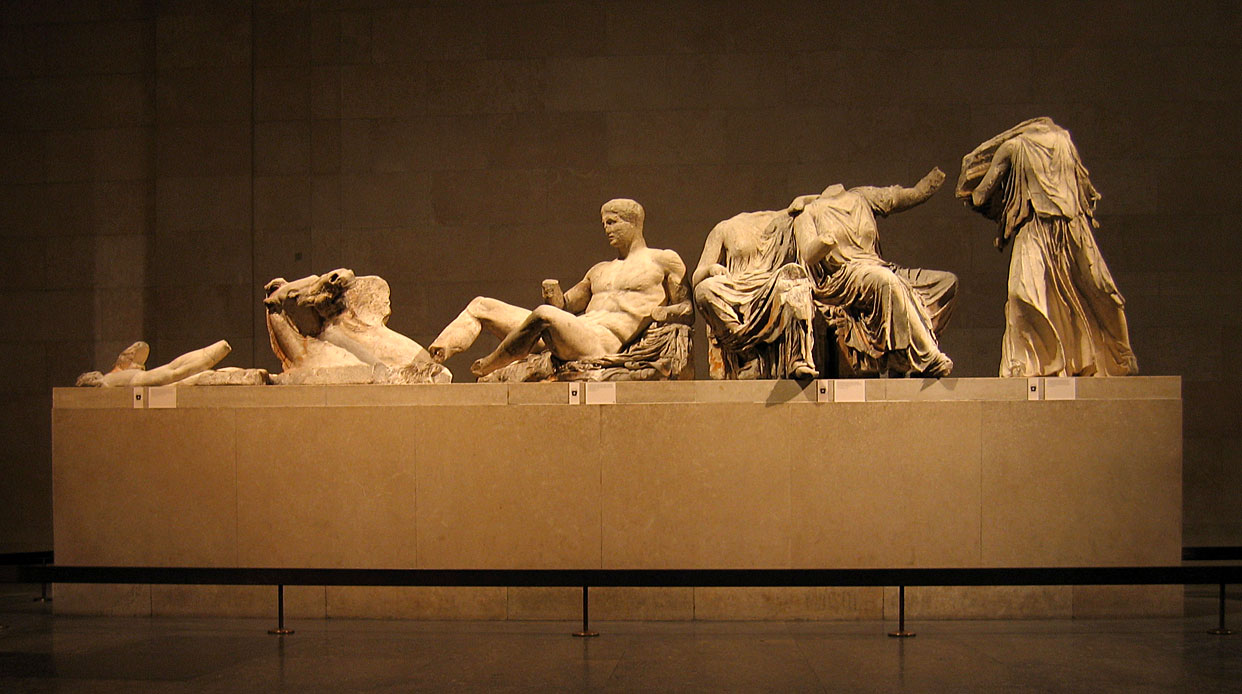
Marbres d’Elgin, Fragments du fronton Est, Ve siècle avant J.-C., Londres, British Museum – Source : https://commons.wikimedia.org/wiki/File:Elgin_Marbles_east_pediment.jpg
Au-delà d'un simple témoignage matériel, les images produites par une société à une époque donnée peuvent incarner une idée politique dominante. Il s'agit donc pour les historiens de l'art d'une tâche complexe, l'analyse de ces images apportant parfois davantage d'informations quant à l'histoire des idées politiques ou révélant l'absence de toute notion idéologique.
 Gilles Sauron February 2010
« Si je prends l'ara Pacis, c'est un témoignage original et où forcément se concentrent des intentions très précises d'un pouvoir politique. Et donc l'historien est obligé de passer par là. C'est pour lui un document très inhabituel parce que ce n'est pas un document écrit mais c'est un document qui a la vertu d'être une expression directe sans médiation d'historiens anciens qui auraient pu déformer les propos. On est en face d'un document original et donc l'historien est forcé de s'intéresser à nous, pour une fois, et de nous demander des détails. C'est vrai aussi des images intimes des maisons. Mais ce sont des niveaux d'information très différents qui peuvent être même dans des décors privés, extrêmement riches pour l'histoire politique. » 3.2.3
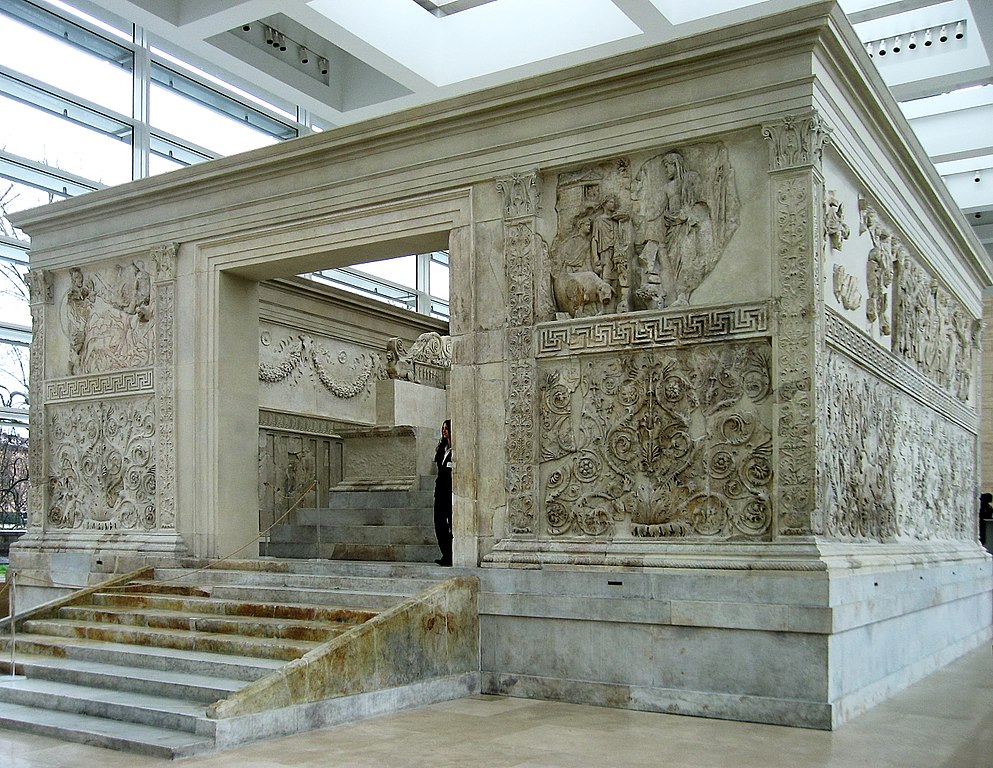
Entrée principale de l’Ara Pacis, Ier siècle avant J.-C., Rome – Source : https://upload.wikimedia.org/wikipedia/commons/thumb/e/e8/Ara_Pacis_Rom.jpg/994px-Ara_Pacis_Rom.jpg
Gilles Sauron February 2010
« Finalement beaucoup d'œuvres d'art ont été faites pour ne pas être vues, comme tous les bijoux qu'on enfermait dans les tombes. Je pense qu'on a une vision très déformée, une vision de visiteur d’exposition ou de musée. Or, ce n'est pas du tout la vision qu'avaient les anciens. En général, tout ce qu'on voit dans les musées, ce sont des choses qui n'étaient pas faites pour être vues. Le public d'aujourd'hui revendique un point de vue de consommateur d’œuvres d’art, c'est une position actuelle, contemporaine, qui en réalité, est en contradiction complète avec la société qui a fait naître ces objets. Si on prend le point de vue antique, il faut vraiment récupérer la mémoire, le comportement, le regard et, à ce moment-là, on arrive un peu à comprendre les choses. De toute façon, je ne suis pas sûr que ce serait la même chose pour la Grèce classique, par exemple, où le rôle du créateur, de l'artiste est beaucoup plus important. On est à la limite dans une situation plus moderne peut-être, plus actuelle, si on regarde de travail des sculpteurs et des peintres grecs. Tandis que la situation romaine est très particulière, c'est vraiment une situation, où l'autorité politique ou le propriétaire, disons le patron, va jouer un rôle essentiel dans la création. » 4.2
 John Boardman June 2002
« It’s becoming quite fashionable nowadays to think that iconography is a reflection of more than narrative storytelling, but of the social or political or whatever background in which it is created, or for which it is created, which must be true. But the degree of truth in that is very difficult to challenge. Is it vitally important every time you see a picture of so and so, were you reminded of the political and social background to it, or was it just another picture of so and so? The origin of which may have been stimulated by a particular circumstance or whatever it might have been, but no more than that. And then it simply becomes a bit of decoration. Sphinxes: if it were a sphinx with a Theban or with Oedipus, that sort of story, it may be that the tradition which had that picture for you was one which was for a particular purpose, and had a certain mood or purpose. It had something to do with Thebes, it had something to do with riddles, I don’t know. Whatever it might be- it could have had a purpose. But as time passes it simply becomes another picture, which has an interesting narrative, and you see it as that and you don’t think any more about it than we do most of the time when we see these things. But then the sphinx is a sphinx, and the sphinx in the Oedipus story is a monster who has human speech and tells riddles and things like that. And then you go along and you see a sphinx on a gravestone, you don’t think of Oedipus. But that image was one which was created for the story, or identified with the Oedipus story. Later on, you’ll find it on your earring. Each context will give it a different significance. And by the time it’s on your earring I should say that it’s probably purely decorative, from a decorative tradition and has no deeper significance whatsoever. » 2.4.3
John Boardman June 2002
« If it has been used in a more social context, or even political context – that reminds of us that we defeated the so and so’s, or that reminds us that such and such thing happened – that would come back into your mind I suppose. But the only way that you can really understand what the point of it was is to get into the mind of on the one hand the viewer, the man for whom it was made for, and on the other hand of the artist, who was making it. Why did he do it? To be looked at. When it’s looked at by someone what does he get out of it when he looks at it? And you can assume that what he gets out of it is what the artist put into it, but we can’t even be sure about that. And out of that context and the period in which it was made, anything can happen. I mean if you look at the Parthenon sculptures a hundred years later, they mean something totally different to what they meant when they were put up. What we should try to understand is what they meant when they were put up. What they mean later on is interesting, but it doesn’t affect our understanding of what happened at the beginning. So scenes change through familiarity or through a different context. When Athens is top dog, Athena means one thing, when it isn’t, she means something else, even if it’s the same statue or image » 3.2.1
L'image est protéiforme. Mise au service d'une idée politique, elle devient la mise en abyme de cette idéologie. L'image elle-même exerce un pouvoir sur le spectateur, il est alors chose aisée de la manipuler et d'en faire l'intermédiaire d'un pouvoir politique. En ce sens l'omniprésence de l'image conforte et entretient une idée, qu'elle soit d'ailleurs politique comme commerciale par exemple.
Martine Denoyelle July 2010
« Il faut se méfier du pouvoir de l'image parce que c'est un pouvoir de fascination. Valeur d'argument, je ne sais pas, mais elles peuvent avoir une valeur démonstrative, par la mise en série. Et d'analyse des variations d'un thème, à travers plusieurs images. En tant qu'argument définitif, je ne suis pas tout à fait sûre que l'image puisse jamais être un argument. » 3.1.2
Gilles Sauron February 2010
« Moi j'ai été particulièrement choqué par la façon dont, en Allemagne, certains commentateurs ont rapproché sans vergogne l’utilisation des images par le pouvoir augustéen des entreprises propagandistes du IIIe Reich, comme si Mécène et Virgile étaient les lointains prédécesseurs de Goebbels et de Leni Riefenstahl. Il y a là une formidable simplification de l’histoire, d’autant plus que les discours idéologiques romains, déjà avant Auguste, s’adaptaient à des publics très différents, dont certains ne se laissaient pas facilement convaincre. » 4.1
Marie-Christine Villanueva Puig September 2012
« En y réfléchissant, je pense qu’il y a un pouvoir considérable. Je pense à toutes les époques et dans l’Antiquité, c’est évident. […] Dans notre société contemporaine, cela me semble évident aussi, mais ce n’est pas neuf. Ce n’est pas ça qui m’a d’abord attiré, c’était une fascination plus esthétique, un monde totalement différent. Je crois effectivement que c’est un énorme pouvoir. On ne peut pas étudier une société ancienne sans leur faire une place. Auprès des historiens, il faut se présenter comme des saltimbanques des images, mais je crois qu’il faut qu’ils nous acceptent. Elles ont un pouvoir et occupent un rôle essentiel dans la documentation. » 1.2.3
 Mary Beard September 2002
« Images have a terribly important power. They have a power to make you think differently about how the world is, basically, in a word. They can change the way you see the world. Or the way you are forced to see the world. » 1.2.3
John North August 2002
« Do you mean power in the sense of political power or propaganda power ? Yes, of course they can have a great deal of power in that sense : in the prorogation of images, and that’s one of the constants, isn’t it, with antiquity, that you put out an image and it fits into other ways of presenting a regime, what the sort of constant presence of Augustus, and the constant presence of Sadaam Hussein, come to that, the constant presence of the smile of Tony Blair. » 1.2.3
John North August 2002
« I think that the propagation of images is in that sense is a huge source of power, yes, and the control of images, and also the control of the images of the past: the capacity to manipulate what happened in the past by presenting images in a particular way. I suspect that photography is the most powerful medium. But I think that in that sense it is a great source of power. I suppose the other way that you might think of it, I don’t know… there are so many ways of power, whichever you go around it, you think that there is power, but the other source of power is what we talked about, that is, perhaps that the art market and the vision of art and all the rest of it is actually a very powerful tool in the hands of a dominant elite, without them particularly realizing that, but it provides them with a weapon. » 1.2.3